
Autores: Teresa Goicolea, María José Aroca-Fernández, Juan Ignacio García Viñas, Santiago Saura, Sergio González-Ávila, Rubén G. Mateo, Aitor Gastón
Publicación: Diversity and Distributions. 2025
Enlace DOI: https://doi.org/10.1111/ddi.70068
Resumen:
Aim
Assess the potential effects of climate change on different forest habitats; and outline a climate-wise conservation network to sustain forest connectivity under current and future climates.
Location
Mainland Spain.
Time Period
Current and future (2071–2100).
Major Taxa Studied
Forest species associated with different vegetation types and dispersal abilities.
Methods
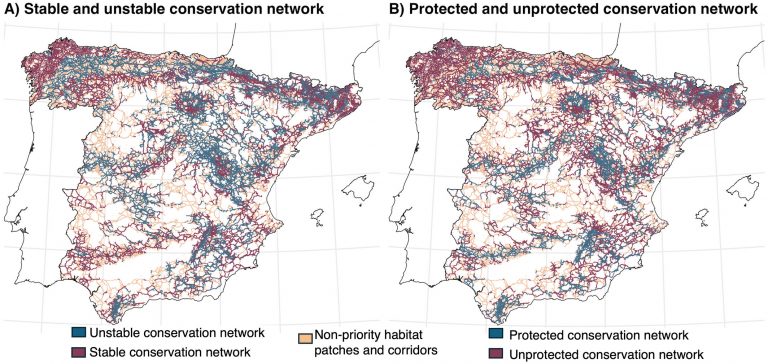
We fitted a Random Forest model to predict the distribution of six vegetation types under current and four future climate scenarios. We then assessed forest availability and connectivity for each climate scenario and vegetation type. To define the conservation network, we identified the key habitat patches and corridors for dynamic connectivity using multi-temporal habitat availability indices. Finally, we analysed how much of the conservation network is expected to change due to climate shifts and how it aligns with existing protected areas.
Results
Forests across all vegetation types exhibited substantial northward and upward shifts. Forests adapted to cold or wet conditions (e.g., deciduous, mountain conifers and high-mountain vegetation) declined in area and connectivity. Warm- and dry-adapted forests (e.g., sclerophyllous, subsclerophyllous and hyperxerophilous vegetation) increased their ranges and/or connectivity. Rates of change in forest area and connectivity were similar within each vegetation type, except for subsclerophyllous vegetation, which lost forest area but gained connectivity. 48% of the proposed conservation network experienced shifts in the vegetation types. Current protected areas covered 41% of the conservation patches across Spain, but less than 7% within the deciduous vegetation type.
Main Conclusions
Projected shifts highlight the need for dynamic connectivity analyses to guide effective conservation under changing climate. Forest types exhibited distinct trends, underscoring the need for tailored strategies for each type. The proposed conservation network provides guidance for a proactive enhancement of Spanish forests’ resilience. It also serves as a reference for other countries with similar conservation targets, including the European Union Nature Restoration Regulation or Biodiversity Strategy for 2030.