

Autores: Cisneros-Araujo, P., Cubero, D., Pinto, D., Salinas, P., Jiménez, F., García, J., Martín, R., Salvador, V., Alonso, C., Gambra, D., García-Viñas, J.I., Gastón, A., Perea, R., San Miguel, A., Saura, S., Ezquerra, J., Rodríguez de Rivera, O.
Publicación: Biological Conservation. 2026.
Enlace DOI: https://doi.org/10.1016/j.biocon.2026.111819
Resumen:
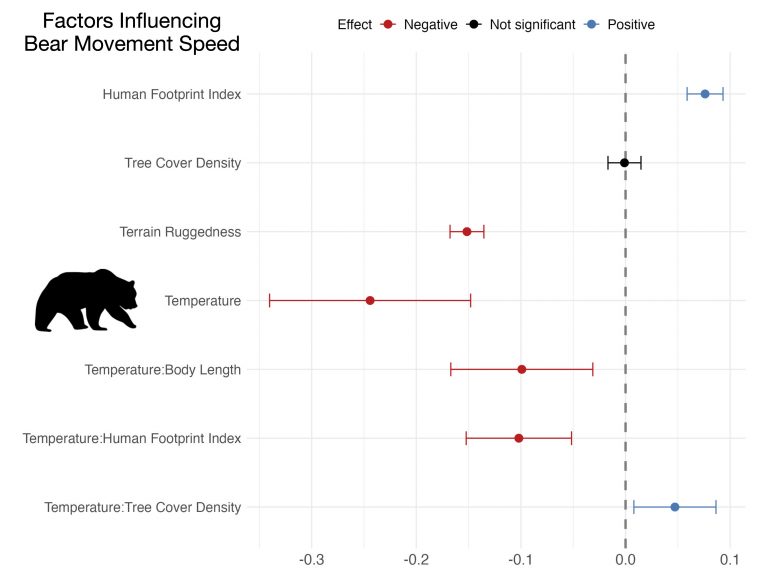
Animal behavior in human-modified landscapes results from complex interactions between environmental and anthropogenic factors. Large mammals, such as bears, are particularly sensitive to human disturbance and heat stress given their limited thermoregulatory capacity. High temperatures can suppress activity and promote nocturnality, confounding behavioral shifts typically attributed to human presence. To separately assess these effects, we used GPS telemetry and hierarchical GAMs to study how local environmental temperature, human footprint, tree cover, and body size jointly shape brown bear movement ecology at its southern range limit in the climate-sensitive and endangered Cantabrian population (NW Spain). Cantabrian bears exhibited a predominantly crepuscular, slightly nocturnal activity pattern intensified by temperature, which emerged as the primary constraint on movement. Larger individuals showed increased nocturnality and stronger reductions in movement speed under high temperatures, consistent with greater heat-dissipation limitations. Conversely, bears moved faster in human-modified areas, likely reflecting a strategy to reduce travel time in areas with potential human encounters and the challenges of navigating fragmented landscapes. However, the negative effect of high temperature on movement was amplified in anthropized areas, potentially limiting bears’ behavioral adjustments and capacity to compensate for fragmentation. Heat constraints were partially mitigated by denser tree cover, underscoring the role of forests as thermal refuges, particularly where rising temperatures increasingly limit spatial and behavioral shifts and challenge resilience. As global warming progresses, heat-buffering measures such as identifying, protecting, and connecting thermal refugia—e.g., forested, shaded north-facing slopes with foraging resources—should be prioritized for conserving bears and other large mammals in warm, human-modified landscapes.