

Autores: Pablo Cisneros-Araujo, Aitor Gastón, David Cubero, Daniel Pinto, Santiago Saura & Óscar Rodríguez de Rivera
Publicación: Landscape Ecology. 2026.
Enlace DOI: https://doi.org/10.1007/s10980-026-02304-3
Resumen:
Context
Identifying the components of movement paths is essential for studying key processes such as space use, habitat selection and connectivity. Although animal movement operates across scales, most segmentation approaches do not differentiate how fine-scale behaviors depend on broader movement phases.
Objectives
We introduce a hidden Markov model (HMM) formulation that jointly analyses fine-scale activity modes (inactive, moving) and broader movement phases (resident, non-resident). Our goal is to provide a flexible and accessible method for segmenting movement trajectories into behaviorally meaningful states within longer-term movement patterns.
Methods
Our framework uses variables directly derived from GPS tracks—step lengths and turning angles—to identify activity modes, and residence time to characterize broader phases. An asymmetric coupled HMM (ACHMM) structure allows activity modes to depend on movement phases, but not vice versa. We demonstrate the model with two illustrative examples and apply it to telemetry data from Cantabrian brown bears, a species with diverse movement strategies, by modeling state transition probabilities as functions of bear identity and time of day (via splines) to examine interindividual variation in diel activity.
Results
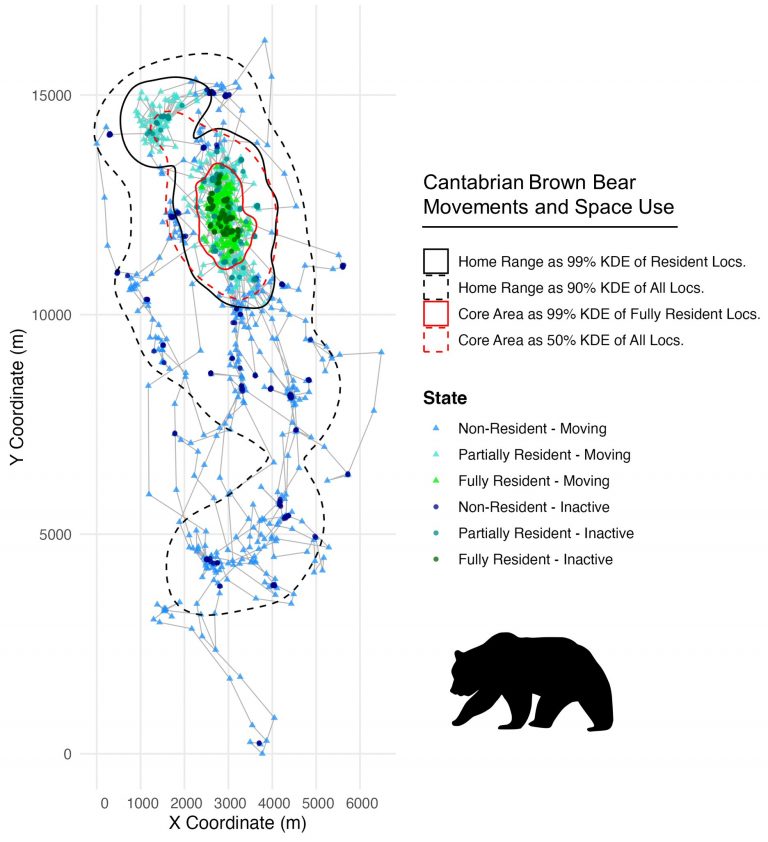
The model effectively segmented trajectories into interpretable states—residence areas, stepping-stones, dispersals, excursions—and provided a biologically informed approach to identifying home ranges and core areas. It also showed that the characteristics of activity modes vary with movement phase and revealed interindividual differences and phase-dependent shifts in bear diel activity patterns.
Conclusions
The ACHMM framework facilitates integrated ecological inference across movement scales, offering a powerful tool for studying how environmental factors jointly shape animal behaviors and movement strategies.