
Autores: Janire Sánchez, Álvaro Francisco Gil and Carlos Calderón-Guerrero
Publicación: Diversity. 2026, 18(3), 169
Enlace DOI: https://doi.org/10.3390/d18030169
Resumen:
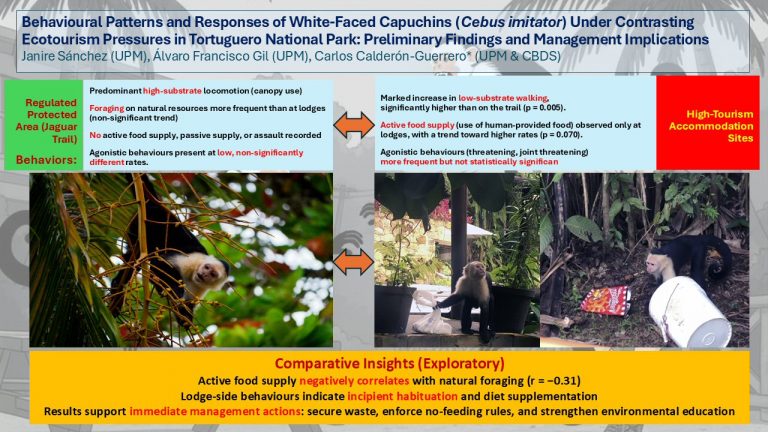
Ecotourism in protected areas creates a conservation paradox: tourism revenue funds protection, yet tourism infrastructure simultaneously degrades the wildlife it protects. We examined this paradox in white-faced capuchins (Cebus imitator) in Tortuguero National Park, comparing behaviour across a high-tourism accommodation site (2152 monthly guests) and a strictly regulated terrestrial trail. Using focal animal and sweep sampling methods, we recorded 477 behavioural units across 261 min, analysing locomotion, feeding, and agonistic behaviours through generalized linear models. Primates in accommodation areas exhibited significantly reduced high substrate use (p = 0.005), showed a trend toward increased anthropogenic food reliance (p = 0.070), and higher—but not statistically significant—rates of agonistic behaviours (p > 0.05). The negative correlation between natural foraging and active food supply (r = −0.31) is consistent with anthropogenic provisioning that may alter primate ecological functions. These findings demonstrate that effective conservation in tourism contexts requires integrated management addressing three interconnected challenges: (1) habituation to human presence, (2) food provisioning with cascading consequences, and (3) ecosystem-level degradation through altered primate functions. We recommend evidence-based interventions including secured waste management, enforcement of wildlife feeding prohibitions, and environmental education programs with community participation. Ecotourism sustainability requires managing human–wildlife interactions and integrating local stakeholder perspectives to preserve animal welfare and ecosystem functions essential for conservation.